

Two shapes dominate the outdoor sauna market, and the choice between them decides more than looks. A barrel and a cabin of the same nominal capacity heat differently, age differently, cost different amounts to install, and suit different backyards. Neither is objectively better. But one of them is almost certainly better for your space, and the deciding factors are more practical than most buyers expect.
Here is how the two compare on the things that matter after the delivery truck leaves.
The Short Answer
Choose a barrel if you want the fastest heat-up, the lowest entry price for genuine outdoor construction, and a compact footprint that still seats three or four. Choose a cabin if you want full standing height, flexible bench layouts, easier roofing over the long term, and a structure that looks intentional rather than decorative in a designed garden.
How the Shapes Actually Perform
Heat-up time and efficiency
A barrel wins here, and the reason is geometry. The curved walls eliminate the corner air that a rectangular room has to heat but nobody sits in, so total interior volume is smaller for the same bench capacity. Heat also circulates naturally around the curve, reducing cold pockets near the floor. In practice a barrel typically reaches temperature 5 to 15 minutes faster than a comparable cabin with the same heater.
Cabins counter with insulation. Thicker wall assemblies and insulated roof systems mean a cabin loses heat more slowly once it is up to temperature, which matters if you run back-to-back sessions or live somewhere genuinely cold. Over a two-hour evening with three rounds, the efficiency gap largely closes.
Interior comfort and layout
This is where cabins pull decisively ahead. Vertical walls mean benches can run the full length of both sides, an upper tier can span the whole room, and you can stand up straight to pour water or move around. Most quality cabins give you over 6'2" of headroom.
In a barrel, the curve dictates bench placement. Seating sits at the widest point, which is comfortable, but headroom drops sharply at the edges and lying down means aligning with the barrel's axis. Three people fit in a well-designed barrel comfortably; three people plus flexibility is a cabin conversation.
Weather and longevity
Barrels shed water beautifully. There is no flat surface for rain or snow to sit on, and the staved construction tightens as the wood swells. The weak points are the flat end walls and the bands, which need occasional tensioning as the timber settles.
Cabins rely on a proper roof system to do the same job. A shingled or membrane roof with drip edges works extremely well, but a poorly detailed roof is the most common failure point in cheap cabin kits. When you compare models, look at the roof spec before you look at the glass.
Best Barrel Sauna for Most Backyards
If a barrel suits your space, the three-person size is the one to buy. It costs marginally more than a two-person model, fits nearly every yard that fits a barrel at all, and gives you the room to lie down that smaller units cannot.

SaunaLife Model E6 Traditional Outdoor Barrel Sauna — ERGO-Series, 3 Person
Made in Nordic Europe and designed around comfort rather than novelty: contoured seating surfaces and arched backrests address the usual barrel complaint, which is that curved walls dig into your back after ten minutes. Three-bather capacity in a 59" diameter shell keeps the footprint modest enough for a narrow yard or a side return.
Best Cabin Sauna for Compact Spaces
The argument against cabins used to be price. It no longer holds at the small end: a two-person cube now costs about the same as a two-person barrel, and buys you standing height and a flat floor.
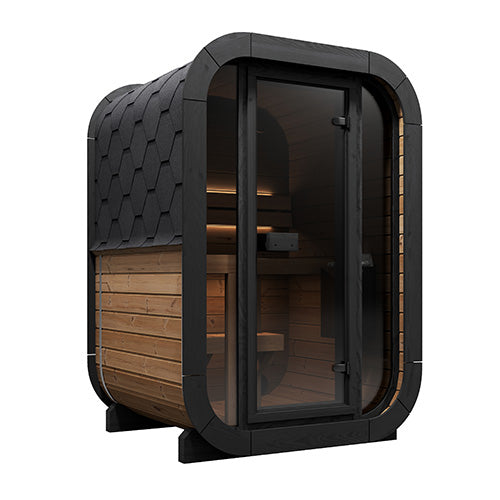
SaunaLife CL3G Cube-Series Outdoor Sauna Kit — 2 Person
A Scandinavian cube with a full-glass front, built from thermally modified spruce that outlasts Western Red Cedar outdoors by a wide margin and resists the seasonal movement that loosens cheaper structures. The glass wall is the real differentiator against a barrel: it makes a small footprint feel considerably larger and turns the sauna into something you look out of rather than sit inside.
Side by Side
| Factor | Barrel Sauna | Cabin Sauna |
|---|---|---|
| Heat-up time | Faster — less dead air volume | Slightly slower, holds heat longer |
| Standing height | Limited at the edges | Full height throughout |
| Bench flexibility | Fixed by the curve | Two-tier layouts, full-length benches |
| Water shedding | Excellent by shape | Depends entirely on roof quality |
| Footprint efficiency | Narrow, needs length | Squarer, easier in a corner |
| Maintenance | Periodic band tensioning | Roof and seal checks |
| Entry price | From around $4,999 | From around $4,940 |
Best Value Barrel Under $5,000
If budget is the deciding constraint rather than shape, the cedar barrel category still offers the most sauna per dollar — particularly at two-person size, where the efficiency advantage of the curve is most pronounced.

Golden Designs "St. Moritz" Traditional Barrel Outdoor Sauna — 2 Person
Pacific premium cedar in the smallest sensible barrel size. The design brief was maximum usable space with minimum excess cubic footage, which is exactly what makes it heat quickly and run cheaply. A sound first outdoor sauna for a couple, or a second unit for a property that already has a larger cabin.
Which One Fits Your Yard?
Measure before you shortlist. A three-person barrel needs a run of roughly 6 to 7 feet of length and about 5 to 6 feet of width, plus clearance for the door swing and access to the rear for the heater and electrics. A cabin of similar capacity tends to be squarer, which makes it easier to tuck into a corner but harder to slide down a narrow side passage.
Also consider sight lines. A barrel is a strong visual statement and reads as a feature object. A cabin with matching cladding can be made to disappear against a fence or a garden wall. Neither is wrong; they just do different things to a garden. Both styles sit side by side in our backyard steam sauna range, and the cedar barrel models cover the cedar barrel end specifically.
Frequently Asked Questions
Is a barrel sauna a real traditional sauna?
Yes. Most barrels use a conventional electric heater and sauna stones, so you get the same high heat and the same ability to pour water for steam. The shape changes the airflow, not the experience.
Which lasts longer, a barrel or a cabin?
Both last twenty years or more if built from treated timber and maintained. What kills them is water: standing water on a badly detailed cabin roof, or loosened bands letting a barrel's staves separate. Build quality decides this, not shape.
Do barrel saunas leak?
A properly assembled barrel does not. The staves swell slightly on first use and tighten against each other. If gaps appear later, the bands need tensioning — a ten-minute job.
Can either style be used indoors?
Cabins adapt to indoor use more easily because they have flat walls and a conventional footprint. Barrels are designed around outdoor placement and rarely make sense inside.
Which is cheaper to run?
Marginally the barrel, because there is less air to heat. The difference across a year of regular use is small — heater size and how long you leave it on matter far more than shape.
The Bottom Line
Buy a barrel if you want quick heat, a compact footprint, and the lowest cost of entry into genuine outdoor sauna construction. Buy a cabin if headroom, bench flexibility, and how the structure looks in a designed garden matter more than shaving ten minutes off warm-up.
For most buyers weighing the two honestly, the deciding factor turns out to be height. If you want to stand up inside your sauna, the decision has already been made — and everything else is detail. Whichever you choose, size the heater for the full interior volume from the start, and add the bucket, ladle and gauges in the same order so the sauna is usable the day it is finished.