

Not everyone has a spare basement, a wide garden, or a dedicated home gym to build a sauna into. For apartment dwellers, condo owners, and anyone working with a tight footprint, the question is not whether a home sauna is possible — it is which one actually fits. The good news: a well-chosen compact sauna delivers the same deep, restorative heat as a full-size cabin while taking up little more floor space than an armchair. This guide walks you through choosing the best sauna for small spaces, what to look for if you are shorter (or taller) than average, and the top models worth considering in 2026.
Whether you are squeezing a unit into a spare corner, a bedroom, a garage nook, or a small bathroom, the priorities are the same: a modest external footprint, a comfortable interior for your height, low power draw so you can run it on a standard outlet, and quick assembly without structural work. Let's break it down.
Why a Compact Sauna Makes Sense for Small Homes
A compact sauna — typically a one- to two-person infrared cabin — is designed to slot into rooms that could never accommodate a traditional Finnish sauna. Most models in this category have an external footprint of roughly 36" to 48" wide and 36" to 42" deep, which means they fit against a single wall in a bedroom, study, or living area without dominating the room.
Because the majority of small indoor saunas use infrared heating rather than a traditional stove, they run on a standard household outlet, heat up in 10–15 minutes, and require no plumbing, venting, or dedicated circuit in most cases. That combination — small footprint, plug-and-play power, fast heat-up — is exactly what makes them practical for apartments and compact homes. You can browse the full range across our home sauna collection to compare sizes side by side.
Infrared vs traditional for small rooms
In a tight space, infrared has three clear advantages. First, the cabinets are slimmer because there is no stove and no rock tray to accommodate. Second, the lower surface temperatures (typically 120–150°F versus 180°F+ in a traditional sauna) mean less heat radiates into the surrounding room, which matters when the sauna shares space with your bedroom or office. Third, the electrical requirements are gentler. If you have the space and the wiring for a traditional cabin, it is a wonderful experience — but for genuinely small rooms, infrared is almost always the more realistic pick. You can see the full lineup of indoor infrared sauna models to compare.
The Overlooked Factor: Interior Height and Bench Depth (Especially for Shorter or Taller Users)
Almost every buying guide obsesses over external footprint and forgets the thing you actually feel once you are inside: the internal dimensions. This matters enormously if you are shorter or taller than average.
If you are on the shorter side, a deep bench can leave your feet dangling or force you to perch forward, which quickly becomes uncomfortable during a 30-minute session. Look for models with a bench depth around 16–18" and an interior height that lets you sit fully upright without stooping. Many compact cabins are built with a lower overall profile precisely because they are single- or two-person units, which often works in a shorter user's favour.
If you are taller, the opposite applies: check the seated headroom and the diagonal length if you like to recline. A cabin that is comfortable for someone at 5'4" can feel cramped at 6'2". The specification tables on each product page list interior width, depth, and height — always read those numbers rather than assuming a "2-person" label means it fits two adults of any size comfortably. When in doubt, a slightly larger two-person cabin gives taller users the room they need while still qualifying as a small-footprint unit.
Power, Assembly and Placement
Three practical checks before you buy:
Power: Most one- and two-person infrared saunas run on a standard 120V outlet drawing around 15–20 amps, so you rarely need an electrician. Confirm the amperage on the product page against the circuit you plan to use, and avoid sharing that circuit with other high-draw appliances.
Assembly: Compact cabins typically ship as pre-built panels that clip together with buckle or latch systems, assembling in 30–60 minutes with one or two people and no specialist tools. This is a genuine advantage in an apartment where you cannot do construction work.
Placement: Leave a few inches of clearance around the cabin for airflow, keep it away from soft furnishings, and place it on a hard, level floor. A small waterproof mat underneath protects carpet or wood.
Top Compact Saunas for Small Spaces in 2026
Here are three standout small indoor saunas that balance a tight footprint with real day-to-day comfort, from a true single-person cabin up to a roomier two-person model. Each links through to full specifications so you can check the exact interior dimensions for your height.
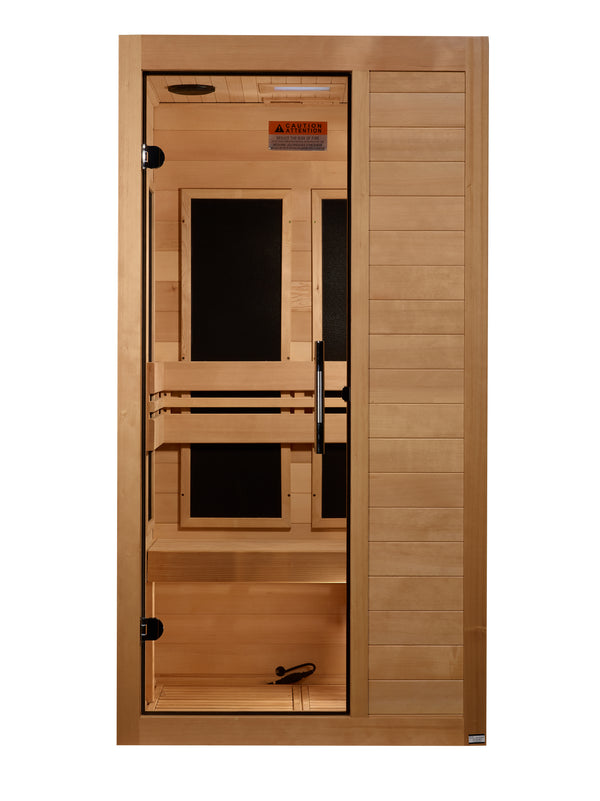
Maxxus “S-Line” 1-Person Low EMF FAR Infrared Sauna
A true single-person cabin with the smallest footprint here — ideal for apartments, offices, and narrow corners. Natural hemlock construction, low-EMF FAR infrared panels, and a standard-outlet plug mean no wiring work. The upright single-seat interior suits shorter users especially well.
If you want a little more room while keeping to a small footprint, the Dynamic Barcelona is our best-value pick — a 1–2 person cabin that is ideal for one and cosy for two.
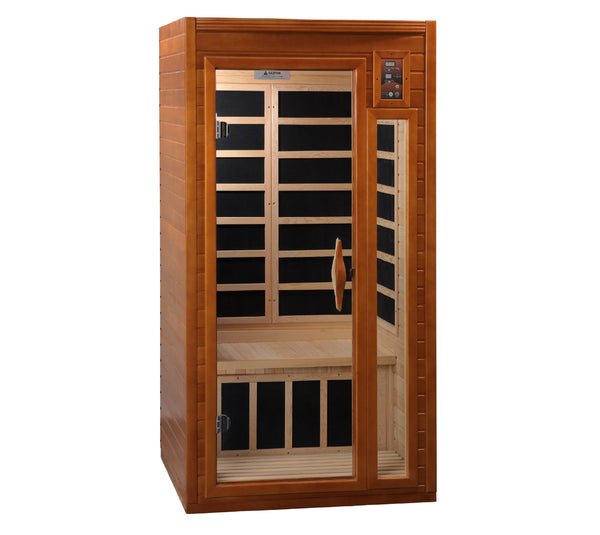
Dynamic “Barcelona” 1–2 Person Low EMF Far Infrared Sauna
Our go-to recommendation for compact rooms. At 39" wide it slots against a single wall, runs on a standard 120V outlet, and assembles in about an hour. Six low-EMF carbon panels, natural hemlock, chromotherapy lighting, and Bluetooth — a lot of sauna for a small space.
Need genuine room for two while staying compact? The Dynamic Santiago is the roomiest of the three, with a warm Canadian Hemlock build and a full two-person interior.
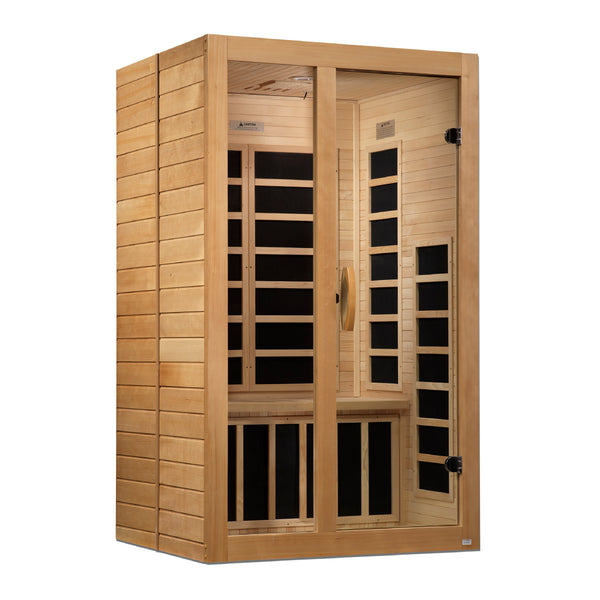
Dynamic “Santiago” 2-Person Low EMF Far Infrared Sauna
A comfortable, well-finished two-person cabin in natural hemlock with a 42"-wide interior — the most headroom and bench space of the three, while still keeping to a small-room footprint. Seven low-EMF carbon panels, chromotherapy lighting, and a standard-outlet plug.
How to Choose the Right One for Your Space
Work through these in order:
1. Measure the room, then add clearance. Note the wall space you can dedicate, then subtract a few inches on each side for airflow. Compare that against the external width and depth on the product page.
2. Match the interior to your height. Shorter users should prioritise a shallower bench and full seated headroom; taller users should check seated headroom and reclining length. The numbers are on every listing.
3. Confirm the power. Check the amperage against your outlet and circuit. Most compact infrared units are standard-outlet friendly.
4. Decide infrared vs traditional. For genuinely small or shared rooms, infrared is usually the practical choice. If you have a dedicated space and the wiring, explore our traditional indoor sauna range too.
Frequently Asked Questions
What is the smallest sauna I can put in an apartment?
One-person and compact two-person infrared cabins are the smallest practical options, with external footprints often around 36–42" square. They run on a standard outlet and assemble without construction work, which makes them apartment-friendly.
Are compact saunas comfortable for shorter people?
They can be more comfortable than large cabins, provided you check the bench depth and interior height. A shallower bench and upright seated headroom prevent the “feet dangling” problem that deep benches cause for shorter users. Always read the interior dimensions on the product page.
Do small saunas need special wiring?
Most compact infrared saunas run on a standard 120V household outlet drawing roughly 15–20 amps, so no special circuit is usually required. Confirm the amperage on the listing and avoid sharing the circuit with other heavy appliances.
How long does a compact sauna take to heat up?
Infrared cabins typically reach operating temperature in about 10–15 minutes, which is faster than a traditional stove-heated sauna and convenient for shorter, more frequent sessions.
The Bottom Line
A small home does not rule out a sauna — it just narrows the shortlist to compact, standard-outlet infrared cabins that fit your footprint and, just as importantly, your height. Measure your space, read the interior dimensions rather than trusting the person-count label, and pick a model that lets you sit comfortably upright. Ready to compare sizes for your room? Browse the full home sauna range and filter down to the compact models that fit your space.