

A backyard sauna changes how you use your outdoor space. It turns a patch of lawn into somewhere you actually go — a short walk through cold air, a cedar door, and a wall of heat waiting on the other side. That small ritual of stepping outside is a large part of why people who own outdoor saunas tend to use them far more often than those with a cabin tucked in a basement.
But a great outdoor sauna is more than a box dropped on the grass. Shape, placement, materials, and the space immediately around it all decide whether it becomes the heart of your garden or an expensive shed you visit twice a year. This guide walks through the design decisions that matter, with layouts and model suggestions to help you plan.
Start With the Shape
The silhouette of your sauna sets the tone for the whole yard, and there are three broad directions to choose from.
Barrel saunas are the iconic choice. The curved ceiling sits closer to the bathers, so the room heats faster and uses less energy than a boxy cabin of the same footprint. Rain and snow run straight off the rounded roof, and the rustic cedar look suits natural, planted gardens. Browse the full range of cedar barrel designs to see the sizes available.
Cube and cabin saunas offer straighter lines, more usable bench space, and a look that sits comfortably alongside modern architecture. They tend to feel roomier inside for the same external footprint because you are not losing corners to the curve. The cabin sauna range covers this style.
Glass-fronted pods are worth considering if your yard has a view — trees, water, a sunset line. A large glass panel turns the sauna into a viewing room and makes a small cabin feel considerably bigger. You will find these across the outdoor sauna collection.
Placement: The Decision People Get Wrong
Where you site the sauna matters more than almost any other choice. Put it too far from the house and you will skip it on cold nights. Put it too close and you lose the sense of retreat. The sweet spot for most homes is a short, well-lit path — close enough for a barefoot dash in winter, far enough that it feels like somewhere separate.
A few practical rules worth following:
Level, well-drained ground. Gravel pads, concrete slabs, or a reinforced deck all work. Standing water is the enemy of any wooden structure, so avoid low spots where rain collects.
Face the door away from prevailing wind. Nothing kills the mood like a gust of cold air every time someone enters or leaves.
Consider the view. If you have something worth looking at, orient the window or glass door toward it before you pour a foundation.
Respect clearances. Keep the required distance from fences and structures, particularly with a wood-burning stove and its chimney.
Check local rules. Some areas require permits for permanent outbuildings or for running a new electrical circuit down the garden.
If you are mapping the project from scratch, our guide on planning a backyard sauna build covers site preparation in more depth, and what your sauna needs electrically is essential reading before you dig a trench.
Design the Zone, Not Just the Cabin
The best backyard saunas are part of a small outdoor sequence rather than isolated boxes. Think about what happens in the minutes before and after your session — that is where the experience is either made or lost.
A simple, effective layout looks like this: a short path with low-level lighting leading to the cabin; a covered spot just outside the door for towels, robes and shoes; a bench or two chairs for the cool-down; and, if you have room, a cold water station a few steps away. Add a fire pit or a few lanterns and you have somewhere people genuinely want to linger on a summer evening.
Small touches with an outsized payoff: warm, low path lighting rather than a harsh floodlight; a gravel or stone landing so you are not stepping onto wet grass; hooks and a small shelf under the eave; and a wind-sheltered corner for the cool-down bench.
Choose Your Heat Source
Outdoor saunas give you a choice that indoor rooms rarely do.
A wood-fired stove delivers the full sensory experience — the crackle, the smell of smoke, the slow build of heat — and needs no electrical supply at all, which can save a significant amount on trenching and wiring. The trade-off is time and effort: you are splitting wood, laying a fire, and waiting.
An electric heater is the low-friction option. Many models now offer app control, so you can start warming the cabin from the sofa and walk out to a room already at temperature. For anyone hoping to use their sauna several times a week, that convenience is usually what keeps the habit alive. Our guide to sizing a heater explains how to match output to room volume.
Materials That Survive the Weather
Outdoor cabins face rain, snow, UV and freeze-thaw cycles that indoor saunas never see, so wood choice genuinely matters. Western Red Cedar remains the benchmark — naturally rot-resistant, dimensionally stable, and it never gets uncomfortably hot to sit on. Thermally treated spruce and aspen are excellent modern alternatives, particularly well suited to harsh climates. For a fuller comparison, see our breakdown of which woods perform best in a sauna.
Whatever you choose, plan for a little maintenance. An annual check of the exterior finish, the roof covering and the door seal will add years to the structure.
Three Outdoor Saunas Worth Considering
Here are three in-stock models that cover the main design directions — a compact modern cube, a roomier cube for small groups, and a classic barrel. Each links through to full specifications so you can check exact dimensions against your space.
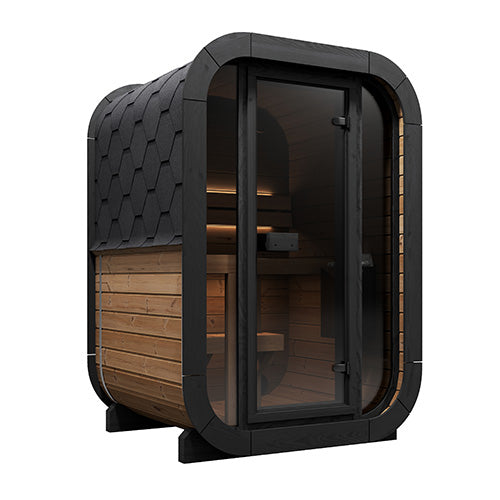
SaunaLife CL3G Cube-Series Outdoor Sauna Kit — 2 Person
A clean-lined Scandinavian cube in thermo-spruce that slots neatly into a small garden or against a deck. Two-person capacity, modern glass front, and a footprint that suits urban yards where a barrel would dominate.
If you need room for a small group while keeping the same modern look, the CL4G steps up the capacity without changing the design language.
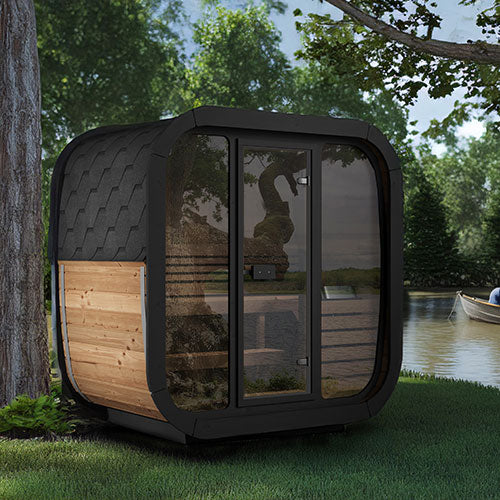
SaunaLife Model CL4G Cube-Series Outdoor Sauna Kit — Up to 3 Persons
The same contemporary cube profile with genuine room for three. A strong choice if the sauna will be a shared feature of the garden rather than a solo retreat, and it still reads as architecture rather than an outbuilding.
And for the classic backyard centrepiece, a cedar barrel remains hard to beat on both looks and heat-up time.
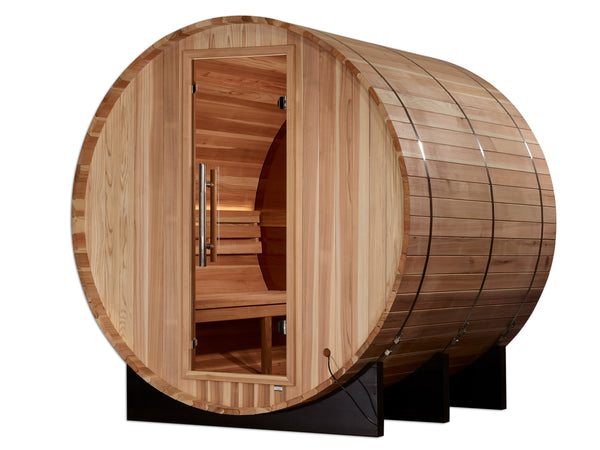
Golden Designs "Zurich" Traditional Barrel Outdoor Sauna — 4 Person
Pacific Premium Cedar with a bronze privacy view panel, so you get natural light without being on display. Four-person capacity, fast heat-up thanks to the barrel profile, and the silhouette that most people picture when they imagine a backyard sauna.
Add the Cold Side
If you are already running power and drainage to the bottom of the garden, adding cold therapy is the single best upgrade you can make. Stepping from heat straight into cold water is the traditional Nordic cycle, and it is what most people describe as the moment the whole thing clicks. A plunge tub beside the cabin completes the sequence, and our guide to pairing heat and cold explains how to structure the rounds.
Three Layouts That Work
The compact corner. A two-person cube or small barrel tucked into a back corner, gravel landing, two chairs, string lights overhead. Minimal footprint, maximum atmosphere — ideal for small urban gardens.
The deck extension. A cube cabin set flush against an existing deck, so the deck itself becomes the cool-down area. No separate path needed, and it reads as part of the house rather than an outbuilding.
The full retreat. Sauna, plunge tub and a covered seating area arranged around a central stone or gravel space, with planting for privacy. This is the version that turns a backyard into a genuine home spa, and it is worth phasing over a couple of seasons rather than doing it all at once.
Frequently Asked Questions
Can an outdoor sauna be used in winter?
Absolutely — winter is when most owners enjoy them most. Good insulation and a correctly sized heater matter more in cold climates, and the contrast between snow and heat is a large part of the appeal.
Do I need a foundation for an outdoor sauna?
You need a level, well-drained base. A compacted gravel pad, concrete slab or reinforced deck all work well. What you must avoid is placing the cabin directly onto soft ground or turf, where moisture will sit against the timber.
How long does an outdoor sauna take to heat up?
Most cabins reach operating temperature in roughly 30–45 minutes, depending on size, insulation, outside temperature and heater output. Barrel designs tend to be at the quicker end because of the reduced air volume.
Can I assemble an outdoor sauna myself?
Most kits are designed for self-assembly with a helper and basic tools. Electrical connections, however, should always be completed by a licensed electrician.
The Bottom Line
A backyard sauna succeeds or fails on the details around it: a sensible path, a level base, a sheltered spot to cool down, and a shape that suits both your space and your climate. Decide on the silhouette first, get the placement right, then choose a heat source that matches how often you will realistically use it. Ready to compare models for your garden? Browse the full outdoor sauna collection and filter by capacity to find the right fit.